Product Messaging Agent: Five-Figure Annual Savings
The Problem
Product copy follows templates. Amazon PDPs need titles, bullets, A+ content. eCommerce sites have their own structures. Sales teams want formatted one-pagers. The templates create consistency—but also redundancy. At Kensington, we outsourced this work to a vendor at five figures annually.
The Approach
I worked with the content team to identify where AI could reduce our vendor dependency. This became one of my more challenging builds—not because the technology couldn't do it, but because agents were new and the iteration cycle was real.
I spent weeks building, testing, and failing in Copilot. This is the part of AI implementation people gloss over: getting it right takes disciplined effort. But the payoff compounds.
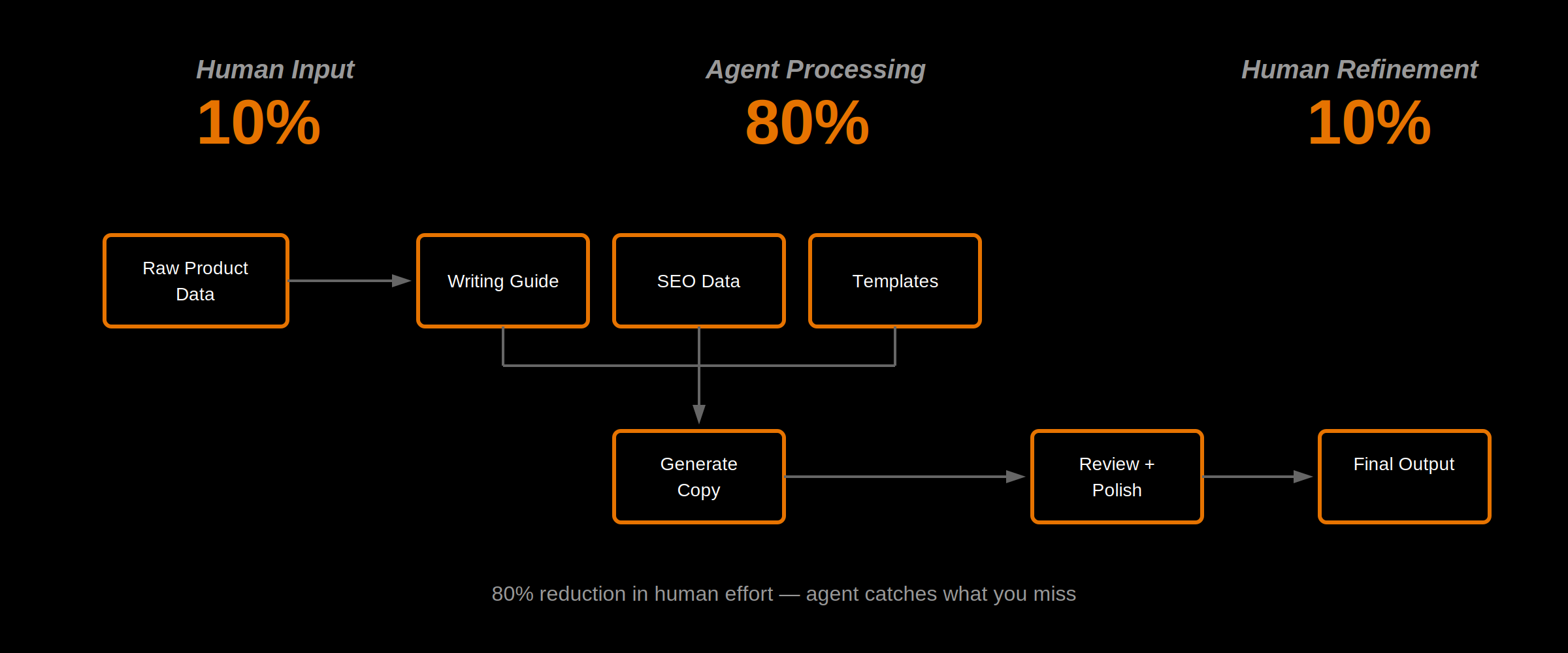
The breakthrough came from the knowledge layer. I uploaded our writing guide, SEO data, and output templates. Then I refined the instructions until a user could input raw product data and get back copy that matched our format—informed by internal standards, structured correctly, ready for review.
Manual cleanup remained. It always does. I think of it as 10-80-10: I spend 10% of the time on input, the agent handles 80%, and I refine the last 10%. That's still an 80% reduction in human effort—and the agent often catches things I'd miss.
The Result
A secure internal agent replaced a five-figure annual vendor cost. The product team now generates copy in-house, faster, with consistent quality.
Tools: Microsoft Copilot, Markdown (VSCode)